Keynotes
We are happy to welcome Daphna Harel and Hadley Wickham as our keynote speakers!
Studying queer data while living it: Positionality, power, and practice
Daphna Harel
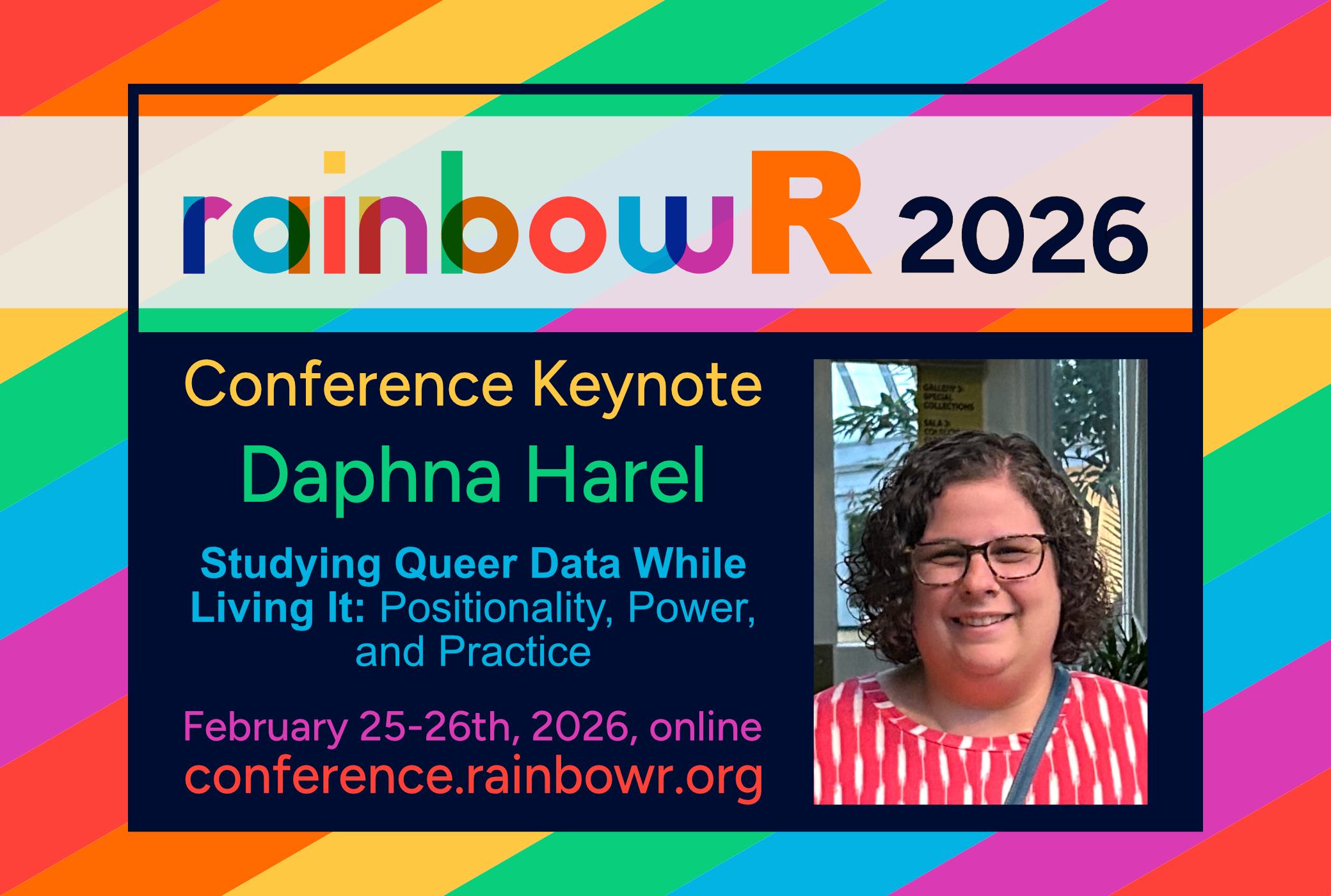
Abstract: What does it mean to study queer data while also living the identities those data attempt to capture? In this talk, I reflect on the opportunities and tensions that arise when queer researchers work with data about queer lives. I explore three interconnected themes. First, positionality: who I am in relation to the data, and how my identity shapes what I see. Second, data as power: who gets counted, categorized, funded, and believed. Finally, practice: how these realities shape what we actually do as researchers. I discuss general practice as a quantitative researcher and explore these themes through a case study drawn from my own experiences designing and analyzing measures of sexual orientation and gender identity (SOGI) in survey research.
Claude Code for R
Hadley Wickham
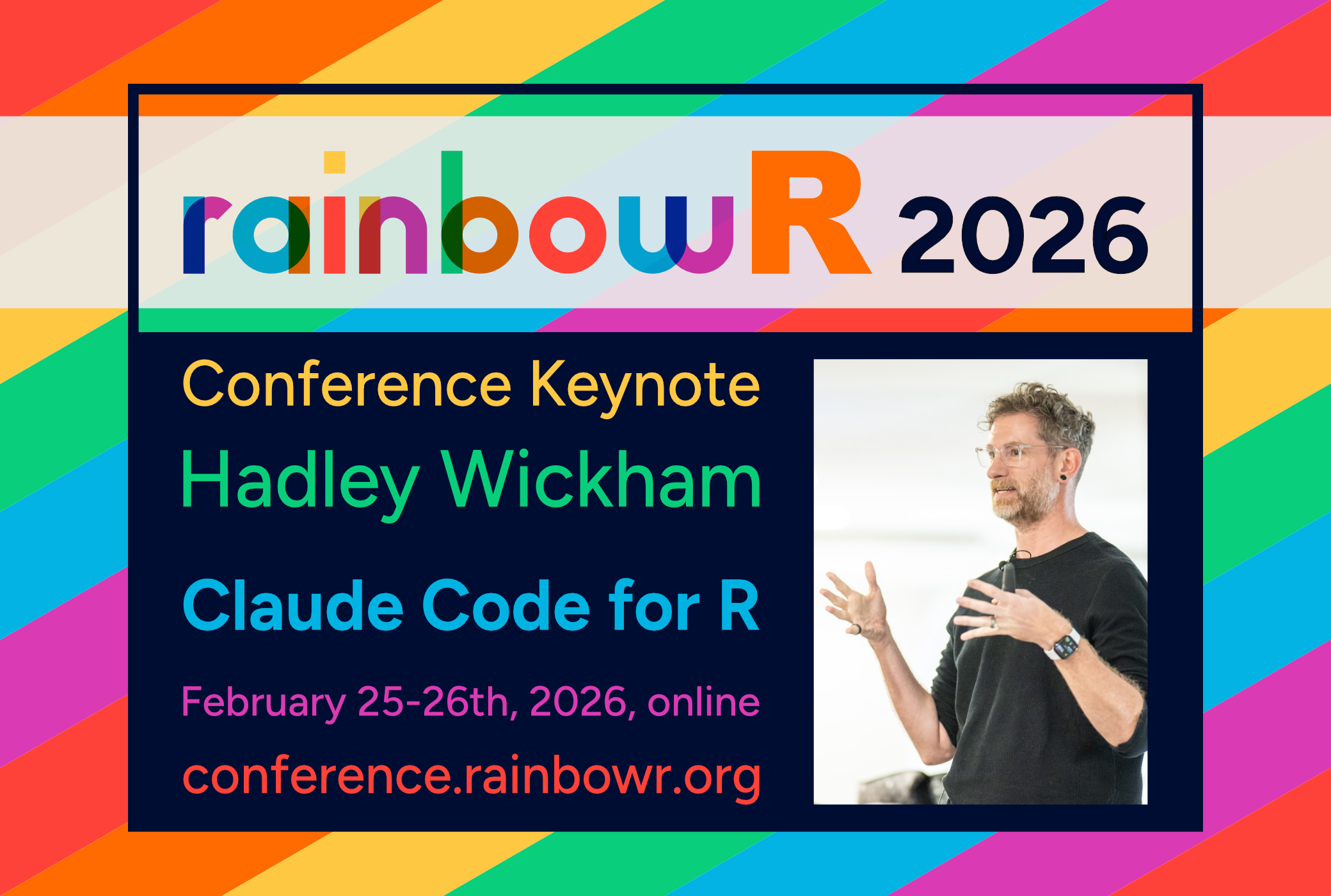
Abstract: If you’ve been paying attention to software engineering social media lately, you might have noticed a lot of noise about Claude Code and the Opus 4.5 model. For me personally, these have pushed AI coding assistance from a “nice to have” to something that feels just as important as git.
In this talk, I’ll show you a couple of my “vibe” coded experiments, but more importantly show you how Claude Code helps me write higher-quality R code faster. I’ve used it a bunch recently for both testthat and dbplyr, two large, well-established code bases where quality is more important than velocity.
Talk recording
Regular talks
20-minute talks will run in two sessions. Open the sections below to read the talk abstracts and access recordings, slides, and other resources.
Talks Session I
Abstract: Intersectionality plays a critical role in understanding LGBTQ+ health, yet most analytic workflows still treat identities like gender, orientation, race, and socioeconomic status as isolated variables. This talk focuses on a practical approach for exploring overlapping identities in clinical and community health datasets using R. I’ll demonstrate how to prepare intersectional data structures, generate membership indicators, and apply UpSet Plots to visualize complex combinations that traditional summaries or Venn diagrams can’t capture. The session highlights how these methods surface disparities in participation, missingness, lab values, and patient-reported outcomes that are often invisible in standard analysis. By grounding the discussion in real analytic challenges, the talk shows how intersectional R workflows support more accurate, inclusive, and ethically responsible health research. Participants will leave with reproducible code examples, practical visualization techniques, and a clear path to integrating intersectional analysis into their own work.
Talk recording GitHub repository Slides
Abstract: Bringing a card game from the dining table to the browser means translating shuffled decks, shouted bids, and partnership dynamics into code (a perfect challenge for AI-assisted development). In this talk, I use Claude Code to build a Pitch (Setback) Shiny app, exploring when AI suggestions hit and when they miss the mark entirely. Pitch is a partnership trick-taking game, making it a natural metaphor for human-AI collaboration: reading your partner’s signals, knowing when to lead, and occasionally getting set back. I’ll cover the technical journey (game state management, reactive logic, UI design) alongside candid reflections on the AI collaboration itself. Expect card game nostalgia, a working Shiny app, and practical takeaways for anyone curious about integrating AI into their R workflow.
Talk recording GitHub repository Slides counselor package
Abstract: Queer stories have existed in film since the earliest decades of cinema, yet identifying and analysing them at scale remains challenging. Queer cinema reflects the social status and lived realities of LGBTQIA+ communities by portraying how norms, power structures, and cultural expectations shape identities and relationships. However, public movie databases often provide incomplete or inconsistently applied metadata, and queer-focused datasets are limited. This project addresses these gaps through the LGBTQ+ Movies Explorer, a Shiny application built in R that visualises patterns of LGBTQ+ representation in films worldwide. The app uses the openly available tidyrainbow LGBTQ+ Movie Database, curated by the R-LGBTQ+ community and derived from TMDb metadata spanning 1882–2022. Through tidyverse workflows, text-mining techniques, and interactive visualisation tools, users can explore LGBTQ+ themes across time, genres, languages, and narrative descriptions. A built-in chatbot assistant supports conversational queries about individual films. Inspired by rainbowR’s focus on visibility and inclusion, the app offers an accessible space to explore how queer stories take shape across global cinema.
Talk recording GitHub repository Slides
Talks Session II
Abstract: This talk introduces the development of an 18-item instrument examining how queer students, staff, and faculty experience belonging within U.S. higher education institutions. Grounded in intersectionality, the survey captures four critical dimensions: Sociopolitical Awareness and Collective Identity, Community Engagement and Participation, Sense of Community and Connection, and Interpersonal Support Networks. We recognize that racism, ableism, transphobia, and classism create vastly different realities for diverse queer communities, making multidimensional measurement crucial. The instrument offers insights by institutional role and includes open-ended demographic questions to honor authentic self-identification. The presentation then opens a discussion on how R can serve as a powerful tool for psychometric validation to ensure the instrument accurately captures belonging experiences across the diverse queer community.
Talk recording Slides
Abstract: As Statistics Canada embraces open-source technologies, migrating from proprietary tools such as SAS to open-source languages like R provides greater flexibility, cost savings, and promotes collaboration. Beyond these benefits, the transition supports the modernization of statistical workflows by rethinking the approaches taken in these workflows. However, converting legacy code in a team environment introduces challenges such as preserving data integrity, adapting complex code, and building team capacity. This presentation outlines a structured approach to migration, emphasizing planning, communication, and training, while addressing technical and organizational hurdles. Lessons learned from the ongoing migration within the Special Economic Statistics Projects methodology section at Statistics Canada will highlight these strategies for other organizations looking to migrate to open-source languages.
Talk recording Slides
Abstract: Rose and Sophia’s Cheesecake business is booming, but they need to optimize their marketing budget!
In this talk, I’ll use the Tidymodels ecosystem in R to construct a comprehensive Marketing Mix Model (MMM). We will move beyond simple linear regression to:
- Engineer Features: Create custom step functions in {recipes} to capture nuanced marketing effects.
- Scale Up: Generalize Tidymodels workflows for efficient model evaluation and scaling.
- Optimize: Use model output to suggest improvements to marketing plans.
Whether you’re new to R, Tidymodels, or MMM, you will leave with the foundational knowledge needed to build a fully interpretable, business-focused sales model.
Talk recording GitHub repository Slides
Lightning Talks
Open the sections below to access recordings, slides, and other resources.